L(-)-carnitine is a trimethylammonium compound involved in anaerobic respiration, stress tolerance, and cellular osmoprotection. Enterobacteria possess a specialized biotransformation pathway that enables the enantioselective production of L(-)-carnitine from crotonobetaine, the dehydrated form of D,L-carnitine. This conversion takes place at the level of coenzyme A (CoA) thioesters, with substrates and products being transported across the cell membrane by the specific betaine/carnitine antiporter CaiT. The pathway is initiated by the ATP-dependent CoA ligase CaiC, which activates the betaine substrate, followed by CaiB, a crotonobetainyl-CoA CoA-transferase that mediates the transfer of the CoA moiety between betaine compounds. Subsequently, the enantioselective hydration of crotonobetainyl-CoA to L(-)-carnitine is catalyzed by the crotonobetainyl-CoA hydratase CaiD [241].
Optimization of L(-)-carnitine production from inexpensive substrates such as crotonobetaine requires the coordinated engineering of central and secondary metabolic pathways. To redirect central carbon metabolism toward the tricarboxylic acid (TCA) cycle, deletion of the aceK gene, which encodes a bifunctional isocitrate dehydrogenase kinase/phosphatase, increases carbon flux through this pathway by preventing the phosphorylation-mediated inhibition of isocitrate dehydrogenase. At the level of secondary metabolism, deletion of caiA, encoding crotonobetainyl-CoA reductase, eliminates a competing carnitine-respiration route and prevents the reduction of crotonobetaine to the byproduct γ-butyrobetaine [241].
Because the native caiTABCDE operon is transcriptionally repressed under aerobic conditions, replacement of its endogenous promoter with a constitutive synthetic promoter, such as p37, enables sustained pathway expression and consequently facilitates L(-)-carnitine production during aerobic cultivation. The combination of these genetic modifications in resting-cell biotransformation systems has been reported to approximately double productivity while enabling nearly complete substrate conversion without significant accumulation of undesirable byproducts [241].
L-carnitine
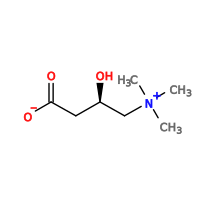
Description
Chemical Formula:
C7H15NO3
Molecular Weight:
161.2 Daltons
Monoisotopic Mass:
162.1130183851 Daltons
SMILES:
C(C(O)CC(=O)[O-])[N+](C)(C)C
InChI:
1S/C7H15NO3/c1-8(2,3)5-6(9)4-7(10)11/h6,9H,4-5H2,1-3H3/t6-/m1/s1
InChIKey:
Synonyms
- γ-trimethyl-hydroxybutyrobetaine
- 3-hydroxy-4-trimethylammoniobutanoate
- R-(-)-3-hydroxy-4-trimethylaminobutyrate
- vitamin B T
- bicarnesine
- (R)-carnitine
- γ-L-trimethyl-β-hydroxybutyrobetaine
- vitamin Bt
- 3-carboxy-2-hydroxy-N,N,N-trimethyl-1-propanaminium
- Levocarnitine
- R(-)-3-hydroxy-4-trimethylaminobutyrate
Databases
MetaCyc:
CARNITINE
RefMet:
Carnitine
BiGG:
crn
MetaboLights:
MTBLC16347
HMDB:
HMDB14721
DRUGBANK:
DB00583
ChemSpider:
10455
PubChem (CID):
10917
ChEBI:
16347
CAS:
541-15-1
44985-71-9
KEGG:
C00318
MetaNetX:
MNXM173
CHEMBL:
CHEMBL1149
NIKKAJI:
J9.362I
PDB-CCD:
152
PupChem (SID):
3612