2,3-oxidosqualene is a linear C30 triterpenoid intermediate in the biosynthetic pathway of sterols and various triterpenoid saponins [1]. It is synthesized from squalene through the regio and stereospecific oxygenation of one of its double bonds, a reaction catalyzed by squalene epoxidase (SE) [42, 43]. This reaction introduces an oxygen atom across the C=C double bond, generating the characteristic epoxide group of 2,3-oxidosqualene [43]. As a central committed precursor, 2,3-oxidosqualene undergoes complex cyclization reactions mediated by oxidosqualene cyclases (OSCs), which generate transient cationic intermediates such as dammarenyl or protosteryl cations [1]. Before cyclization, the molecule adopts specific folded conformations that facilitate the formation of distinct cyclic products, including a chair-boat-chair-boat conformation during sterol biosynthesis and a chair-chair-chair-boat conformation during triterpene biosynthesis [1]. In some organisms, 2,3-oxidosqualene is produced from isopentenyl diphosphate and dimethylallyl diphosphate through the sequential activities of farnesyl diphosphate synthase, squalene synthase, and squalene epoxidase [48].
2,3-oxidosqualene serves as a critical metabolic branch point for the heterologous production of bioactive triterpenoids, including ginsenosides and aglycones such as protopanaxadiol and oleanolic acid [1, 48]. Metabolic engineering strategies aimed at increasing triterpenoid production commonly focus on enhancing the intracellular availability of 2,3 oxidosqualene through the overexpression of upstream enzymes, including 3-hydroxy-3-methylglutaryl-CoA reductase, squalene synthase, and squalene epoxidase [1, 48]. Carbon flux can also be redirected toward specific target products by reducing competing reactions that consume 2,3-oxidosqualene, including those catalyzed by cycloartenol synthase [1]. Furthermore, the selection and expression of different squalene epoxidase isoforms can influence the availability of 2,3-oxidosqualene and thereby regulate the synthesis of specific triterpene and phytosterol products [1].
(3S)-2,3-epoxy-2,3-dihydrosqualene
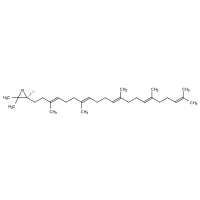
Description
Chemical Formula:
C30H50O
Molecular Weight:
426.724 Daltons
Monoisotopic Mass:
426.3861662271 Daltons
SMILES:
CC(C)=CCCC(C)=CCCC(C)=CCCC=C(C)CCC=C(C)CC[CH]1(C(C)(C)O1)
InChI:
1S/C30H50O/c1-24(2)14-11-17-27(5)20-12-18-25(3)15-9-10-16-26(4)19-13-21-28(6)22-23-29-30(7,8)31-29/h14-16,20-21,29H,9-13,17-19,22-23H2,1-8H3/b25-15+,26-16+,27-20+,28-21+/t29-/m0/s1
InChIKey:
Synonyms
- squalene 2,3-epoxide
- squalene 2,3-oxide
- (S)-squalene-2,3-epoxide
- 2,3-EDSQ
- 2,3-epoxisqualene
- oxidosqualene
- 2,3-oxidosqualene
- (3S)-2,3-epoxysqualene
- (S)-2,3-Epoxysqualene
- (S)-2,3-oxidosqualene
- squalene epoxide
- (3S)-2,3-oxidosqualene
Databases
MetaCyc:
EPOXYSQUALENE
PubChem (CID):
5459811
MetaboLights:
MTBLC15441
HMDB:
HMDB01188
ChEBI:
15441
ChemSpider:
4444080
KEGG:
C01054
PupChem (SID):
4295
LIPID MAPS:
LMPR0106010010
PDB-CCD:
2TX
NIKKAJI:
J39.259F
Reactome:
191309
Seed:
cpd00776
MetaNetX:
MNXM130
KNApSAcK:
C00007282
3DMET:
B01373
CAS:
9029-62-3
BiGG:
Ssq23epx