Crocetin is a symmetrical C20 dicarboxylic apocarotenoid with an unsaturated conjugated polyenoic acid structure derived from the oxidative cleavage of zeaxanthin [19]. Together with its glycosylated derivatives (crocins), it is responsible for the characteristic intense red pigmentation of the stigmas of plants belonging to the Crocus genus, particularly saffron (Crocus sativus) [19, 20]. Biosynthetically, crocetin is produced from zeaxanthin through two consecutive enzymatic steps. First, the plastidial/cytoplasmic carotenoid cleavage dioxygenase 2 (CsCCD2) catalyzes the sequential symmetrical cleavage of the C7–C8 and C7′–C8′ double bonds adjacent to the 3-OH-β-ionone rings, releasing the unstable intermediate crocetin dialdehyde and 3-OH-β-cyclocitral [19, 20]. Although the zeaxanthin cleavage dioxygenase (CsZCD) was initially proposed to initiate this pathway, subsequent studies demonstrated that ZCD is actually an N-terminally truncated form of CCD4 lacking catalytic cleavage activity [19, 20]. In the second step, crocetin dialdehyde is oxidized to crocetin by an aldehyde dehydrogenase (ALDH) [19, 20]. Chemically, the protonated molecular ion of free crocetin exhibits a mass-to-charge ratio of m/z = 329.17 in mass spectrometric analyses [19, 20].
Crocetin is a high-value metabolite with considerable potential in the pharmaceutical, food, and cosmetic industries due to its diverse biological activities, including antioxidant, antiapoptotic, antihyperlipidemic, antiatherosclerotic, and anticancer properties [20]. To overcome the limitations associated with costly traditional plant extraction, heterologous production platforms have been developed for its sustainable biosynthesis in recombinant microorganisms [20]. In bacteria such as Escherichia coli, metabolic engineering strategies focus on reconstructing the downstream biosynthetic pathway in strains optimized for zeaxanthin accumulation [20]. This is achieved by expressing the Crocus sativus dioxygenase CsCCD2 together with an efficient aldehyde dehydrogenase for the oxidation of the crocetin dialdehyde precursor, with the fungal enzyme ALD8 from Neurospora crassa (or the plant enzyme ALD3 from saffron) showing the highest efficiency in the bacterial host [20]. In addition, optimization of cultivation conditions has demonstrated that low fermentation temperatures (approximately 20 °C) are critical for ensuring the proper folding and functional maturation of CsCCD2 [20]. The resulting free crocetin also serves as the direct precursor for the biosynthesis of various crocin esters through the expression of glycosyltransferases of plant or bacterial origin, such as YjiC, YdhE, and YojK from Bacillus subtilis [20].
crocetin
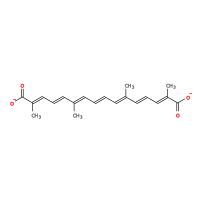
Description
Chemical Formula:
C20H22O4
Molecular Weight:
326.391 Daltons
Monoisotopic Mass:
328.16745925879997 Daltons
SMILES:
CC(=CC=CC=C(C)C=CC=C(C)C(=O)[O-])C=CC=C(C)C(=O)[O-]
InChI:
1S/C20H24O4/c1-15(11-7-13-17(3)19(21)22)9-5-6-10-16(2)12-8-14-18(4)20(23)24/h5-14H,1-4H3,(H,21,22)(H,23,24)/p-2/b6-5+,11-7+,12-8+,15-9+,16-10+,17-13+,18-14+
InChIKey:
Databases
MetaCyc:
CPD-8662
ChEBI:
62767
PubChem (CID):
25244519
KEGG:
C08588
Seed:
cpd05495
MetaNetX:
MNXM3952