Indirubin
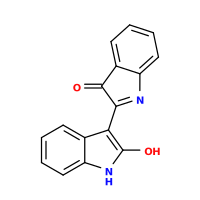
Description
Indirubin is an indole alkaloid and a structural isomer of indigo with significant pharmaceutical properties [12, 16]. It is recognized as the principal bioactive component of the traditional Chinese medicine Danggui Longhui Wan, which has been used for the treatment of chronic myeloid leukemia [12, 16]. Biologically, indirubin acts as a potent inhibitor of cyclin-dependent kinases (CDKs) and glycogen synthase kinase-3β (GSK-3β), highlighting its therapeutic potential for the treatment of cancer and Alzheimer's disease [12, 16]. Structurally, it is formed through the spontaneous dimerization of one molecule of 2-hydroxyindole and one molecule of 3-hydroxyindole (indoxyl) [12, 16].
Indirubin is a major target for the sustainable production of pharmaceuticals using microbial cell factories, aiming to overcome the limitations of chemical synthesis and the costly extraction from plants such as Indigofera tinctoria and Isatis tinctoria [12, 16]. Its production has been achieved in recombinant Escherichia coli through the expression of flavin-containing monooxygenase (FMO) genes, which catalyze the hydroxylation of indole derived from tryptophan [6, 15]. A key strategy for improving indirubin production is cysteine supplementation, which modulates the regioselectivity of FMO to favor the synthesis of 2-hydroxyindole over 3-hydroxyindole [12, 16]. In addition, de novo production from glucose has been achieved by optimizing the shikimate and tryptophan biosynthetic pathways through deletion of the trpR repressor, elimination of feedback inhibition in aroG and trpE, and inactivation of the pyruvate kinase genes pykA and pykF to increase precursor availability [12]. However, intracellular accumulation of indirubin crystals can impose cellular stress and limit the growth of the production strain [16].
Chemical Formula:
C16H10N2O2
Molecular Weight:
262.26 Daltons
Monoisotopic Mass:
262.074228 Daltons
SMILES:
C1=CC=C2C(=C1)C(=C(N2)O)C3=NC4=CC=CC=C4C3=O
InChI:
1S/C16H10N2O2/c19-15-10-6-2-4-8-12(10)17-14(15)13-9-5-1-3-7-11(9)18-16(13)20/h1-8,18,20H
InChIKey:
Synonyms
- Indigo red
- Indigopurpurin
- Couroupitine B