Indigo is an insoluble blue pigment produced through the oxidation of indole catalyzed by enzymes such as flavin-containing monooxygenases (FMOs) or naphthalene dioxygenases, followed by spontaneous dimerization [15, 16]. In the FMO-mediated biosynthetic pathway, indole is first oxidized to indole oxide, which is subsequently converted into indoxyl (3-hydroxyindole). The non-enzymatic dimerization of two indoxyl molecules then yields indigo [12, 15]. Traditionally, indigo has been extracted from plants belonging to the genera Indigofera, Isatis, Polygonum, and Lonchocarpus [16].
Indigo is a major target for the sustainable production of dyes using microbial cell factories as an environmentally friendly alternative to conventional chemical synthesis [15, 16]. Metabolic engineering strategies have focused on increasing intracellular indole availability by deleting the trpR repressor, relieving feedback inhibition of aroG and trpE, and enhancing phosphoenolpyruvate (PEP) and erythrose-4-phosphate (E4P) supply through pykA and pykF deletion together with tktA overexpression [12]. In addition, cysteine supplementation has been used to modulate the regioselectivity of FMO, as elevated cysteine levels favor hydroxylation at the C-2 position of indole, thereby promoting indirubin formation instead of indigo [12, 16].
indigo
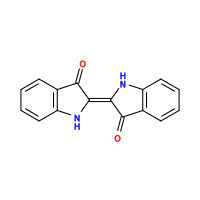
Description
Chemical Formula:
C16H10N2O2
Molecular Weight:
262.267 Daltons
Monoisotopic Mass:
262.0742275756 Daltons
SMILES:
C4(C=CC3(=C(C(=O)C(=C1(C(=O)C2(=C(N1)C=CC=C2)))N3)C=4))
InChI:
1S/C16H10N2O2/c19-15-9-5-1-3-7-11(9)17-13(15)14-16(20)10-6-2-4-8-12(10)18-14/h1-8,17-18H/b14-13+
InChIKey:
Synonyms
- indigotin
- cystoceva
- diindogen
- vulcafix blue R
Databases
MetaCyc:
CPD-10525
ChemSpider:
4477009
Seed:
cpd22702
MetaNetX:
MNXM18650